
Between November 2019 and March 2020, Covid-19, a novel coronavirus contracted through contact with droplets of infected persons, spread rapidly from its site of origin, Wuhan, China to the rest of the world. As governments and international organisations fought to control the spread and maintain stability, the WHO declared Covid-19 a pandemic on 11th March 2020.
From this moment, the lives of Caribbean people were dramatically transformed. Along with most other countries in the world, mandatory quarantine, border closings and societal shutdowns were instituted and industries and services were brought to a standstill as health authorities around the world fought to contain the deadly contagion and the race for a vaccine intensified. Social distancing, compulsory mask wearing and stay at home orders became the new normal and stringent public health measures were implemented.
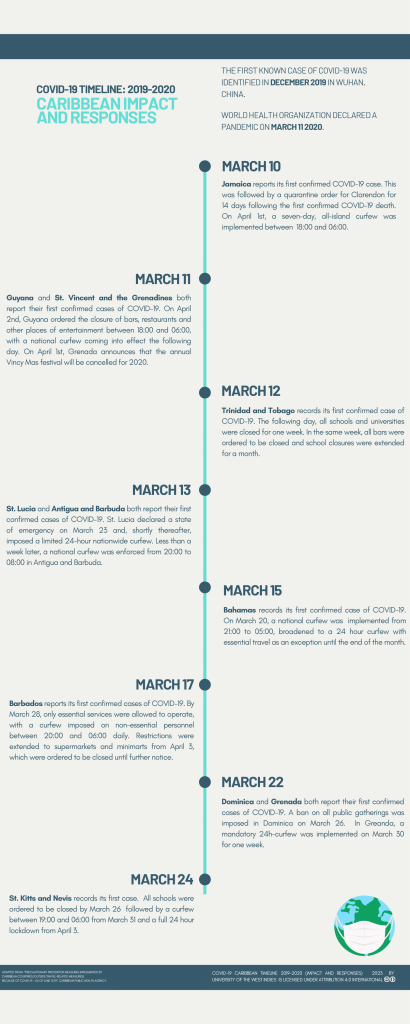
As a result, every sphere of human life and interaction – public health, employment, culture, the economy, politics, education and our digital technological engagement- was affected by the subsequent lock-downs, State of Emergency declarations, curfews and our efforts to maintain some form of functionality in the midst of the chaos.
Financial instability due to the loss of income and disrupted employment, political upheaval as governments differed in their management and response to the pandemic and social unrest became common. But as with most crises, both drawbacks and advantages were observed. Innovation and advancement in digital engagement and the delivery of social services also became characteristic of the period. Consequently, it has become critical for academic scholars to capture the stories of those who have been affected, even as the crisis persists, to preserve these accounts for historical study.

The comparison as well of the reactions and responses to the pandemic of Caribbean territories is also an emerging and essential focus of study. As a watershed moment in the history of the world and the Caribbean, it is incumbent upon historians and scholars to record and analyse this recent history and to make the collected historical material accessible to future researchers and policy makers.
Sources:
Garavito et al (2020), “COVID-19: The Caribbean Crisis: Results from an Online Socioeconomic Survey” Inter-American Development Bank, http://dx.doi.org/10.18235/0002602
Pereira, S. and Yañez‑Pagans, P., 2021. New Data Shows the Impacts of the Pandemic on Caribbean Businesses.
IDB. August 25 https://idbinvest.org/en/blog/development‑impact/new‑data‑shows‑impacts‑pandemic‑caribbean‑
businesses
M. Parker and P. Alfaro, “Education during the COVID-19 pandemic: access, inclusion and psychosocial support”
Studies and Perspectives series-ECLAC Subregional Headquarters for the Caribbean, No. 104 (LC/TS.2021/211-LC/CAR/TS.2021/6), Santiago, Economic Commission for Latin America and the Caribbean (ECLAC), 2022.
Seon, Quinta, Sandeep Maharaj, Darren Dookeeram, Kareema Ali, and Terence Seemungal. “Leveraging Research, Community and Collaboration towards Robust COVID-19 Mental Health Response in the Caribbean.” The Lancet Regional Health – Americas 19 (March 1, 2023): 100440. https://doi.org/10.1016/j.lana.2023.100440.
World Bank. “The World Bank in the Caribbean – Overview.” Accessed September 4, 2023. https://www.worldbank.org/en/country/caribbean/overview.
 The Caribbean Corona Chronicles
